

















Flag Features
Standard flagpole format with Delmarva wind-rated four-side stitched edges — 200D nylon and brass grommets for Delaware’s flat, open peninsula geography and year-round coastal outdoor exposure
Stitched Edges — All Four Sides
Delaware’s flat Delmarva Peninsula geography amplifies wind exposure compared to topographically sheltered states. Nor’easters producing sustained 35–55 mph winds sweep across the Peninsula with minimal friction or deflection, concentrating tensile load on the fly edge of a 3×5 flag panel at levels that unstitched edges cannot sustain without fraying. The folded and sewn perimeter on all four sides encases cut fiber ends and distributes stress along the full hem length — the edge construction that delivers multi-season Delaware flagpole life.
3×5 Ft Standard Format
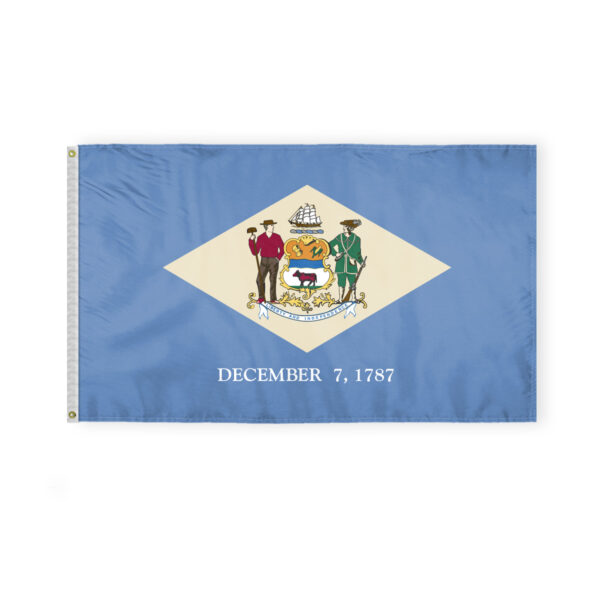
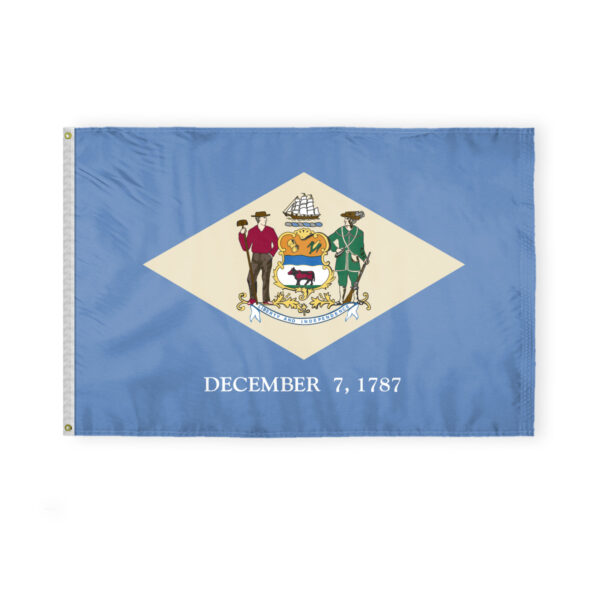
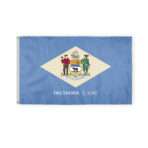
The recognized standard for U.S. residential and commercial outdoor flagpole display, and the size at which Delaware’s coat of arms with its farmer, militiaman, ship, wheat sheaf, and ox is individually visible from standard 30–100 foot viewing distances. At 3×5, Delaware’s buff diamond is at its full 3-foot hoist dimension, read correctly at the pole-top viewing distances of Dover, Newark, and Wilmington residential and commercial flagpoles.
Double Sided Reverse Print
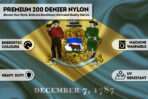
Full-color Delaware flag on the front face — colonial buff diamond, coat of arms, motto, 1787 date — and a natural mirror image at identical saturation on the reverse. At 3×5, Delaware’s buff diamond is visible from all viewing angles around the flagpole as the flag turns in Delaware’s variable and reversing Delmarva winds. Standard and correct for single-pole year-round outdoor display.
200D Nylon — Dye-Sub Fade Proof
200D nylon with dye-sublimation color addresses Delaware’s most flag-challenging condition: the buff diamond. Colonial buff is the most UV-sensitive color on any Delaware flag — surface-printed buff shifts to pale yellow-white within one Delmarva beach season. Dye-sublimation drives the buff into the nylon fiber, maintaining the warm tan-gold tone that is Delaware’s defining visual characteristic across multiple outdoor seasons.
Brass Grommets — Reinforced Header
The grommets on a 3×5 Delaware flag carry more hanging load and dynamic wind stress than those on a 2×3. During Delaware’s nor’easter events, the 3×5 panel generates sudden high-magnitude lateral forces on the grommet attachment points. Brass in reinforced header fabric distributes load across the full grommet area. Corrosion-proof in Delaware’s coastal salt air across all three counties — no rust staining on the colonial blue nylon field across multiple Delaware outdoor seasons.
Official Delaware Flag — 1913 Design
Delaware’s 1913 state flag at 3×5 standard scale — colonial buff diamond on colonial blue, 1777 coat of arms at its full 3-foot visibility scale, “Liberty and Independence” motto, December 7, 1787. The First State’s flag at the size that standard Delaware flagpole hardware is designed for — the format at which Delaware’s entire founding story is legible from the street.
Why Choose Us
Standard Format, Stitched Edges — Built for Delaware’s Flagpole Wind Environment
A 3×5 polyester flag with an unstitched edge and steel grommets is not a cheaper version of this flag on a Delaware outdoor pole — it is a flag that frays at the fly edge during the first nor’easter, fades within one Delmarva beach season as the colonial buff turns yellow-white, and corrodes at the grommets in Delaware’s coastal salt air. Stitched-edge 200D nylon with brass grommets and dye-sublimation color addresses all three Delaware-specific failure modes.
Stitched-Edge 200D Nylon vs. Generic Polyester for Delaware Outdoor Flagpole Display
3×5 Ft · 200D Nylon · Stitched Edges · Brass Grommets · Double Sided
- Stitched edges all four sides — Delmarva nor’easter wind rated; prevents fly-edge fraying
- 200D nylon — non-absorbent; correct outdoor standard for Delaware’s coastal salt air
- Dye-sublimation — colonial buff warmth in fiber; does not fade to yellow-white under Delmarva UV
- Brass grommets — no corrosion in Delaware coastal salt air; no rust staining on nylon
- Double sided — full Delaware flag at equal saturation on both faces; omnidirectional pole display
- Indoor/outdoor — correct for year-round exposed Delaware outdoor poles and institutional floor stands
Polyester · Unstitched Edge · Steel Grommets
- Unstitched or single-fold edge — frays at fly edge during first Delaware nor’easter wind event
- Polyester — absorbs salt spray; UV-degrades faster on Delaware’s exposed flat Delmarva poles
- Surface print — colonial buff fades to yellow-white within one Delmarva beach UV season
- Steel grommets — corrode in Delaware coastal salt air; rust stains colonial blue nylon field
- Single-sided or poor bleed — Delaware design absent or faint on reverse in omnidirectional wind
- Not rated for Delaware’s nor’easter sustained wind load on exposed Delmarva Peninsula poles
| Feature | This Stitched-Edge Nylon Flag | Generic Polyester Flag |
|---|---|---|
| Edge Construction | Stitched All Four Sides — Nor’easter Wind Rated; Multi-Season Delmarva Fly-Edge Life | Unstitched or Single-Fold — Frays at Fly Edge During First Delaware Nor’easter Event |
| Buff Color | Dye-Sub in Fiber — Warm Tan-Gold Maintained Through Multiple Delmarva Outdoor Seasons | Surface Print — Colonial Buff Fades to Yellow-White Within One Delaware Beach UV Season |
| Material | 200D Nylon — Non-Absorbent; Flies in Light Delmarva Coastal Breeze; Nor’easter Rated | Polyester — Absorbs Salt Spray; Stiffer Weave; UV-Degrades Faster at Delmarva Beach Exposure |
| Grommets | Brass — Corrosion-Proof in Delaware Salt Air; No Rust Staining on Colonial Blue Nylon | Steel or Zinc — Corrode in Delaware Coastal Salt Air; Permanent Rust Stains on Flag Fabric |
| Double-Sided | Full-Color Delaware Flag Both Faces — Buff Diamond Visible as Flag Turns in Variable Delmarva Winds | Single-Sided or Bleed-Through — Buff Diamond Absent or Faint on Reverse in Omnidirectional Wind |
| Service Life | 2–4 Seasons of Managed Delaware Outdoor Display with Nor’easter Removal Protocol | Typically One Delaware Outdoor Season Before Fly-Edge Fraying or Buff Color Failure |
30-Day Satisfaction Guarantee
Return within 30 days for a full refund — no questions asked.
Ships Same Day
Orders before 2 PM EST ship same day — on your Delaware flagpole before nor’easter season.
Delmarva-Grade Stitching
Stitched edges on all four sides — the construction that separates multi-season Delaware flagpole flags from flags that fray in the first Delmarva winter.
Official Delaware Design
The 1913 Delaware flag at 3×5 standard scale — buff diamond, 1777 coat of arms, December 7, 1787, at the size standard Delaware flagpole hardware is designed for.
Care & Maintenance
Keeping your Delaware 3×5 nylon flag through multiple Delmarva outdoor seasons
-
Nor’easter Protocol — Remove Above 35 MPH
Remove the flag during nor’easter events and any sustained wind above 35 mph. Delaware’s Delmarva Peninsula is one of the most nor’easter-exposed locations on the East Coast for flat geography — the Peninsula’s orientation running SSW to NNE is nearly parallel to typical nor’easter tracking paths, concentrating coastal wind exposure on the full length of Delaware’s 96-mile north-to-south extent. The National Weather Service office in Mount Holly, NJ issues coastal wind advisories and high wind warnings for Delaware — these advisories are the flag removal trigger for Delaware residents from New Castle County to Sussex County. Even the stitched-edge 200D nylon construction accumulates fly-edge fatigue at sustained 50+ mph nor’easter velocities. Consistent wind management is the single most effective flag life extension practice for Delaware outdoor flagpole owners.
-
Washing
Machine wash on a gentle cycle in cold water with mild detergent. Air dry completely — do not tumble dry. For Delaware outdoor flags near the coast, salt spray accumulates on the nylon weave through the beach season even at inland distances of 5–10 miles from the Delaware Bay or Atlantic shore on east and southeast wind days. Salt spray is most significant during onshore wind events in July and August when prevailing winds push marine air across Sussex County and the lower Kent County peninsula. Wash every 6–8 weeks during the active beach season (June–September) to prevent salt crystal accumulation from becoming abrasive to the dye-sublimation layer over the full season, particularly at the buff diamond area where color accuracy is most critical.
-
Stitching Inspection
Inspect the perimeter stitching at the start of each Delaware outdoor season and after each nor’easter event. The fly edge is the highest-stress location in Delaware’s wind environment. Look for broken stitches, pulled threads, or any section where the folded hem has begun to separate. A small section of broken stitching on the fly edge can be reinforced with a hand-sewn repair before it progresses under the next nor’easter event. For Delaware government buildings and institutions where the flag flies continuously, designate a facilities person to check stitching at the start of each quarter and after each significant wind event. Hem separation longer than 3–4 inches on the fly edge should be repaired before the flag is re-raised for Delaware’s nor’easter season.
-
Snap Hook & Halyard Inspection
Inspect snap hooks and halyard rope at the start of each Delaware outdoor season and after each nor’easter event. Delaware’s nor’easter events stress the full flag hardware assembly, not just the flag. Snap hooks should click positively closed under light finger pressure — a hook that no longer closes securely should be replaced before the next wind event. Inspect the halyard rope for fraying and UV bleaching, particularly at the snap hook attachment points and the cleat friction points where the rope wears fastest. For coastal Delaware properties where the halyard is made of natural fiber rather than synthetic, the combination of salt air and UV accelerates halyard degradation — replace natural fiber halyards with UV-resistant synthetic rope for year-round Delaware coastal exposure.
Need the compact format for a shorter Delaware residential pole, porch bracket, or balcony rail? The PromoPatriot Delaware State Flag 2×3 Ft uses the same 200D nylon and brass grommet construction — the correct size for poles under 20 feet, Wilmington rowhouse brackets, and Sussex County beach cottage poles.
Shop Delaware 2×3 Ft Compact Flag →Delmarva nor’easter wind rated perimeter reinforcement — Delaware’s flat peninsula geography amplifies wind exposure with no topographic shelter; stitched edges on all four sides are the minimum edge construction for multi-season 3×5 flagpole display on Delaware’s exposed Delmarva poles
All-season Delaware outdoor standard — dye-sublimation color in fiber maintains colonial buff’s warm tan-gold tone through Delmarva beach UV and nor’easter wind cycling; the spec that prevents the buff-to-yellow-white fade that defeats surface-printed Delaware flags
Recognized standard for 20–40 ft residential and commercial flagpoles; Delaware’s coat of arms with farmer, militiaman, ship, wheat sheaf, and ox at the scale visible from 30–100 ft flagpole viewing distances across Delaware’s flat geography
December 7, 1787 — Delaware’s unanimous 30-0 ratification vote in Dover made Delaware the First State; the colonial buff and blue that represents the Delaware Regiment’s uniform at 3×5 standard scale on Delaware’s residential, commercial, and government poles
Frequently Asked Questions
Everything you need to know about the PromoPatriot Delaware State Flag 3×5 Ft
Yes, the 3×5 format is meaningfully different from the 2×3 on this point, and Delaware’s geography makes the difference more consequential here than in most states. A 3×5 flag panel has 150% more surface area than a 2×3 panel — 15 square feet vs. 6 square feet. Aerodynamic force scales with area, so at any given wind speed, the 3×5 panel generates roughly 2.5 times the total aerodynamic load of a 2×3 panel. Delaware’s Delmarva Peninsula geography amplifies this because the state has no significant topographic features to shelter flagpoles from prevailing winds. During a moderate nor’easter at 45 mph sustained, a 3×5 flag on a 25-foot Dover residential pole generates approximately 20–25 pounds of total aerodynamic force. The fly edge — the free vertical edge opposite the grommets — carries the highest concentrated tensile load as the flag oscillates and snaps in turbulent wind. On an unstitched edge, where the cut nylon fibers are directly exposed, this tensile load concentrates at the weakest cut fibers and propagates fraying inward from the edge. The stitched hem encases those cut fiber ends and distributes the tensile stress along the stitching thread. The 2×3 flag, at its smaller panel area, generates proportionally lower total aerodynamic load and the fly-edge stress is lower — the edge construction appropriate for the 2×3 scale is not automatically appropriate at 3×5. In Delaware’s nor’easter environment, a stitched-edge 3×5 will typically survive multiple nor’easter seasons; an unstitched 3×5 may show significant fly-edge fraying after a single Delaware winter on an exposed Delmarva pole.
The traditional proportion guideline for flagpole-to-flag sizing specifies the flag’s hoist (shorter dimension, 3 feet for this flag) should be approximately one-quarter to one-third of the flagpole height. At one-quarter, 3 feet is correct for a 12-foot pole; at one-third, correct for a 9-foot pole. The practical display range for the 3×5 in Delaware is 20–40 feet for residential and commercial poles. At 20 feet, the 3×5 is toward the larger end of standard proportion and looks slightly prominent on the pole, though it is entirely conventional for residential use. At 25–35 feet, the 3×5 is in the ideal proportion range for most Delaware residential flagpoles — the 25-foot in-ground pole is the most common format in Dover, Newark, Middletown, and Smyrna residential neighborhoods. At 40 feet, found primarily on commercial and institutional properties in Wilmington and Dover, the 3×5 is at the smaller end of proportion and a 4×6 format would be better sized, though 3×5 is functionally correct. For Delaware’s suburban residential neighborhoods in New Castle and Kent counties, the 25–30 foot in-ground pole is the standard, and the 3×5 is precisely the correct flag. For Sussex County beach community poles that are 15–20 feet (common in beach communities with HOA height restrictions), both the 2×3 and 3×5 can work, with the 2×3 being the better proportion at 15 feet and the 3×5 at 20 feet.
Yes. The 3×5 format in 200D nylon with stitched edges and brass grommets is the standard specification for year-round institutional outdoor flagpole display in Delaware, and is used at Delaware state government buildings, county government complexes, Delaware State Police barracks, schools, and public institutions throughout all three counties. Delaware state law requires the display of the Delaware state flag alongside the U.S. flag at state government buildings. The Delaware Code, Title 29, Chapter 3 addresses flag display requirements for state institutions. For outdoor institutional flagpoles that fly the flag year-round without bringing it in during winter, the stitched-edge 200D nylon construction is specifically what is needed — not as a premium option but as the minimum correct specification for continuous outdoor institutional display in Delaware’s four-season nor’easter environment. Government procurement for Delaware state flags may be subject to Delaware state procurement code requirements including Made-in-USA sourcing for some procurement categories; purchasing managers for government display should verify applicable requirements for their specific agency beyond the material specification.
Service life depends on location and management practices. For a well-managed Delaware residential installation — where the flag is removed during nor’easter advisories and sustained winds above 35 mph, washed periodically to remove salt accumulation, and inspected at the start and end of each season — expected service life for this 3×5 stitched-edge 200D nylon flag is 18 months to 3 years of active outdoor display at most Delaware residential locations. At exposed coastal Sussex County or Delaware Bayshore New Castle County locations with higher nor’easter and salt air exposure, plan for 18–24 months with consistent wind management. At more sheltered interior Delaware locations in Dover, Newark, and Middletown, 2–3 years of managed display is achievable. The dominant end-of-life factor in Delaware is the combination of fly-edge fatigue from nor’easter wind cycling and colonial buff color accuracy — the flag will typically show fly-edge wear or buff color shift before the overall nylon body fails. The dye-sublimation buff tone has a longer accurate-color service life than surface-printed buff, so the first visible aging indicator may be fly-edge stitching wear at exposed Delmarva locations rather than color degradation. At well-sheltered inland Delaware locations with consistent nor’easter management, color accuracy may outlast stitching life.
The visual difference between 2×3 and 3×5 for Delaware’s flag is significant because of the coat of arms content inside the buff diamond. At 2×3 format, the buff diamond is 2 feet in its full dimension — the coat of arms shield is approximately 8–10 inches tall, and from a 15–20 foot sidewalk viewing distance, the individual figures (farmer, militiaman, ship) are distinguishable as figures but not in full detail. The “Liberty and Independence” motto and the December 7 date are legible from 10–15 feet. At 3×5 format, the buff diamond is 3 feet in its full dimension — the coat of arms shield is 12–14 inches tall, and from the 30–60 foot viewing distances of a typical 25-foot residential flagpole, the individual figures are distinctly visible and the motto and date are legible. This matters for Delaware in a way it does not for simpler state flags: Delaware’s flag carries more narrative content per square inch than most U.S. state flags. A viewer who can read the coat of arms at the 3×5 scale — seeing the farmer with his hoe, the militiaman with his musket, the sailing ship, the wheat sheaf — is reading Delaware’s complete colonial economic and military history. At 2×3, that content is present but not fully legible at typical flagpole distances. The 3×5 is the format at which Delaware’s flag fully communicates everything it was designed to say.
Return within 30 days in original, unused condition for a full refund — prepaid return label provided. Defects in print quality, stitching integrity, nylon construction, or grommet installation replaced free within 30 days — no return required on defective items. Normal wear from Delaware outdoor display — gradual colonial buff color shift from accumulated UV after multiple seasons, fly-edge stitching wear from sustained nor’easter wind cycling, minor nylon texture change from salt air cycling — is expected product aging from regular use in Delaware’s outdoor environment and not a manufacturing defect. Damage from display during sustained severe weather events including nor’easters at wind speeds exceeding the flag’s design envelope is not covered under the defect replacement policy.
 USA American Printed Flags
 USA Embroidered American Flags – Cotton
 USA Embroidered Ceremonial Flags With Gold Fringe
 USA American Printed Stick Flags
 USA American Patriotic Flat Flags
 USA Pleated Fan Flags
 USA Garden Flags
 USA Toothpick Flags
 USA Streamers
 USA Pull Down Flags
 USA Windsocks
 USA American Car Flags
 USA Official Sizes Embroidered Flags
 Alabama
 Alaska
 Arizona
 Arkansas
 California
 Colorado
 Connecticut
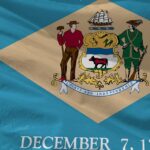 Delaware
 District of Columbia
 Florida
 Georgia
 Hawaii
 Idaho
Idaho Indiana
 lowa
lowa Illinois
 Kansas
 Kentucky
 Louisiana
 Maine
Maine Maryland
 Massachusetts
 Michigan
 Minnesota
 Mississippi
 Missouri
 Montana
 Nebraska
 Nevada
 New Hampshire
 New Jersey
 New Mexico
 New York
 South Carolina
 North Carolina
 North Dakota
 Ohio
Ohio Oklahoma
 Oregon
 Pennsylvania
 Puerto Rico
 Rhode Island
 South Dakota
 Tennessee
 Texas
Texas Texas Sewn
 Utah
Utah Vermont
 Virgin Islands
 Virginia
 Washington
 West Virginia
 Wisconsin
 Wyoming
 Air Force
 Air Force Retired
 Coast Guard
 Coast Gaurd Retired Flags
 Navy
Navy U.S. Army
 U.S. Army Retired
 Support Our Troops – Camou
 Support Our Troops – Yellow
 Prisoners Of War Flags -Black
 Prisoners Of War Flags – Red
 Special Military Flags
 Civilian Flags
 4X6 INCH Mini Racing Stick Flags
 24X30 INCH Racing Flags
 30X30 INCH Checkered Racing Flags
 Checkered Premium Car Flags
 Calico Jack Reckham Pirate Design
 Classic Jolly Roger Pirate Design
 Henry Every Pirate Design
 One Eyed Jack Pirate Design
 Pirate Hat Design
 Buddhist Flags
 Christian Flags
 Episcopal Flags
 Islamic Flags – Black Seal
 Islamic Flags – White Seal
 Israel- Zion Flags
 Jesus Fish Flags
 Lutheran Rose
 Methodist Flags
 Papal Flags
 Presbyterian Religious Flags
 United Church of Christ Flags
 Bow Pennants
 Code & Answering Pennant
 International Maritme Code Flags
 Message Flags
 Nautical Officers Flags
 Novelty Boat Flags
 Number Pennant
 Substitute Pennants
 Yacht Flags
 Numbered Golf Flags -Black Text On Yellow- Tube
 Numbered Golf Flags -Red Text On White- Tube
 Numbered Golf Flags -White Text On Red – Grommet
 Numbered Golf Flags -White Text On Red – Tube
 Plain Golf Flags With Grommets
 Plain Golf Flags With Tube
 Semaphore Golf Flags -Numbers 1-18 – Tubed
 14X18 INCH Golf Direction Flags
 12″X18″ – 19th Hole Golf Flag
 Ecology Flag
 Blue Peace Flag
 15′ Universal Peace Streamers
 Earth Flag
 American Peace Flag
 Embroidered Peace Symbol Flags
 Peace Symbol Flags
 4″X6″ Historical Stick Flags
 First Navy Jack
 Betsy Ross Flags
 Bennington Flag
 Gadsden Flag
 Happy Valentines Day
 St Patricks Day
 Blank Flags
 Funeral Flags
 Halloween Flags
Reviews
There are no reviews yet.